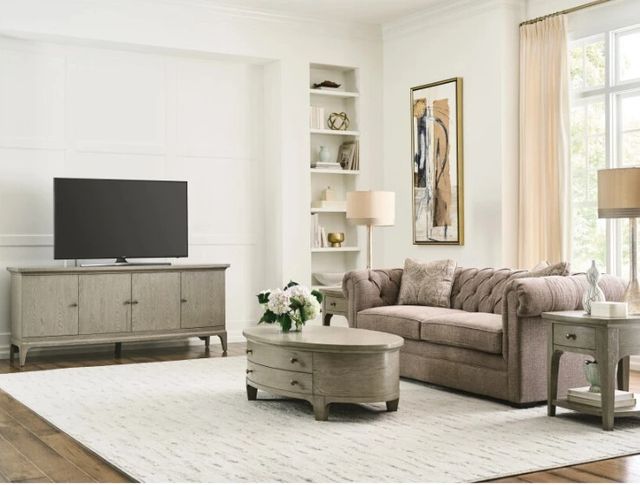
The sofa finally sits where it should and the rug is the right size, which took two tries and a return. Then there is the lamp, balanced on a stack of hardcover books because the base is too narrow to stand on its own, and the arm of the couch doing duty as a coaster, a remote holder and a landing pad for reading glasses, with two faint rings in the fabric to show for it. The table bought from a photo turned out to sit four inches below the armrest, so reaching for a drink means looking down and groping sideways. Choosing end tables for living room seating is one of those decisions that looks purely decorative until the wrong height makes the whole corner unusable.
Find End Tables That Fit Your Seating, Not Just Your Style
Our furniture team helps CSRA shoppers compare heights, finishes and proportions in person, against real sofas and real chairs, before anything gets delivered. Shop occasional tables at Kelley Appliance Center with local delivery, in-home placement and service you can call back on.
Here is what makes this easier than it feels: almost every one of those problems is a measurement problem with a known answer. At Kelley Appliance Center, shoppers from Augusta, Martinez, Evans and Aiken can set a table beside real seating in our showroom and see the height relationship before committing, which is the one thing a product photo will never show. This guide covers how to size end tables for living room seating, which shapes work in which layouts, how materials hold up in a real household, how to coordinate style without buying a matched set, which storage features are worth paying for, and how to style the top without burying it.
Key Takeaways
• Height beats looks every time: The tabletop should sit level with the sofa arm or up to about two inches below it, and a table that misses that range will feel wrong no matter how good it looks.
• Standard heights run 18 to 28 inches: Most end tables land near 24 inches, with recliners calling for something lower and armless sofas calling for something taller.
• Material decides how it survives your household: Solid wood, glass, metal, stone and woven materials each fail in a different way, and matching that to kids, pets and sunlight matters more than matching it to a color.
• Matching sets are optional now: Coordinating by finish tone, undertone and leg shape reads as more considered than buying three pieces from the same box.
What End Tables Do in a Living Room and Why the Right One Matters
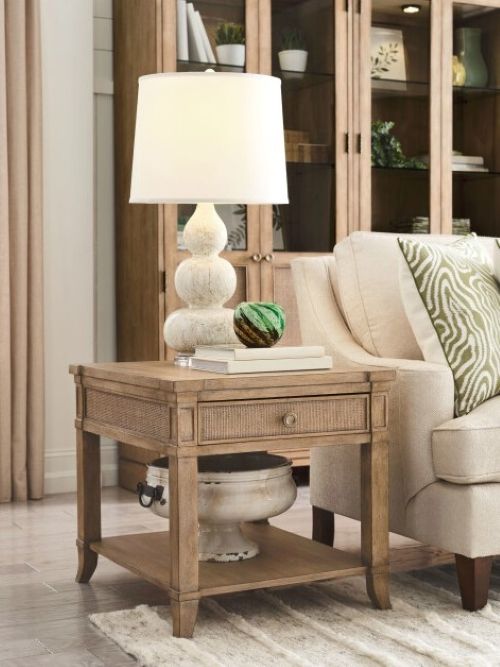
An end table is a small table placed beside a seat, sized so that a person sitting down can reach the top without leaning. That definition sounds obvious until you look at everything it gets confused with.
• Side table: Often used interchangeably, but generally any small table anywhere in a room rather than specifically beside seating.
• Accent table: Chosen primarily for visual interest, sometimes with no functional job at all.
• C-table: A cantilevered table with a base that slides under a sofa so the top hovers over your lap.
• Console table: Long, narrow and tall, made for behind a sofa or against a wall rather than beside a chair.
• Nesting tables: A set of two or three that tuck under each other and pull out when you need more surface.
The practical jobs are the reason these pieces exist: holding a lamp at reading height, catching drinks and remotes, hosting a charger, storing a book and a pair of glasses, and giving the ends of a seating group visual weight so the sofa does not appear to float.
The design job matters too. A matched pair flanking a sofa creates symmetry and makes a room read as deliberately arranged. A single table at one end suits an asymmetrical layout, a small apartment, or a room where a walkway needs the other end left open.
The Mistakes That Show Up Later
• Buying entirely on appearance and discovering the height is wrong after delivery.
• Ignoring seating height, which is the single most common error.
• Choosing a table deeper than the sofa, which throws off the whole line of the seating group.
• Placing a table where it narrows a walkway below comfortable clearance.
• Underestimating what the surface actually needs to hold.
Run a two-minute audit before you shop. Sit in your normal spot, look at the sofa arm and the floor beside it, and write down everything that currently lands there: a phone, a laptop, a coffee mug, a stack of mail, two remotes, a charging cable, a book. That list tells you whether you need a bare surface, a drawer, a shelf or a full cabinet, and it is more useful than any style category.
How to Size End Tables for Living Room Seating
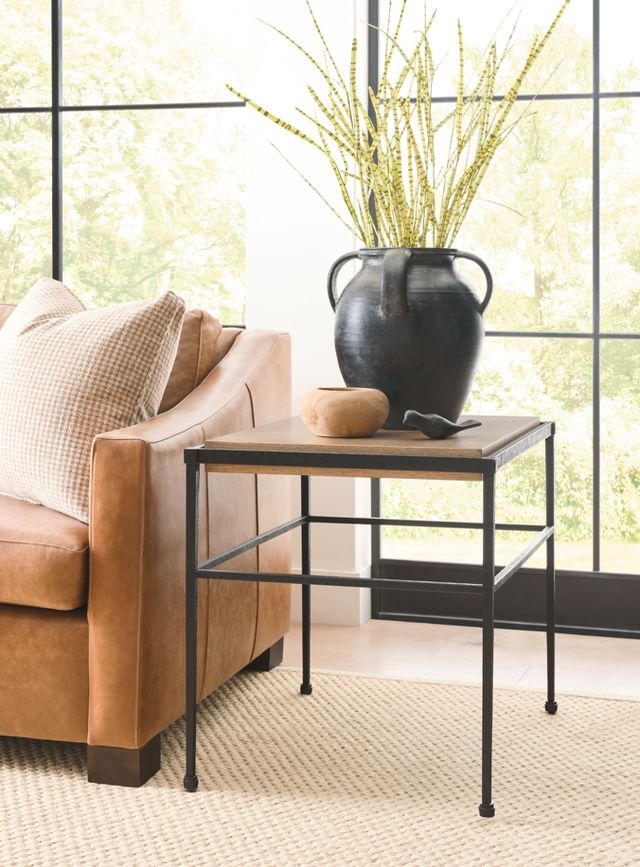
Standard end table height runs roughly 18 to 28 inches, and most pieces land near 24 inches. That range exists because seating heights vary, and the table needs to match the seat rather than a universal number.
The armrest rule is the one to memorize: the tabletop should sit level with the top of the sofa arm, or up to about two inches below it. That relationship lets you reach sideways and set a glass down without looking, which is the entire point of the piece.
Width generally runs about 16 to 28 inches. Depth should not exceed the depth of the sofa, since a table sticking out past the front of the seating breaks the line of the arrangement and becomes a shin hazard in a walkway.
Adjustments for Specific Seating
• Armless sofas and settees: Go taller, since there is no arm to match. Aim near the height of the seat back or use the seat height plus roughly 12 to 16 inches as a starting point.
• Recliners: Go lower and narrower. The table has to clear the extended footrest in front and the reclined back behind, so a tall table that works beside a fixed chair will be in the way twice a day.
• Sectional corners: Choose a low profile that preserves sightlines across the seating group, since a tall table in a corner blocks conversation.
• Accent chairs: Match the chair arm, which is frequently lower than a sofa arm in the same room.
Clearance and Traffic Flow
Leave roughly 30 to 36 inches for a main walkway through a room and about 18 inches between a coffee table and the sofa front. Between the end table and the sofa arm, leave a small gap of an inch or two rather than pushing them tight together, which prevents scuffed upholstery and makes both pieces easier to clean around.
Measuring at Home
1. Measure from the floor to the top of the sofa arm. This is your target height.
2. Measure from the front of the seat cushion to the back of the frame. This is your maximum depth.
3. Measure the open floor space beside the sofa, wall to sofa. This is your maximum width.
4. Measure the walkway you need to preserve and subtract it from the available space.
Here is the reach test our furniture team recommends before anyone commits: stack books beside your sofa to the exact height of the table you are considering, put a full glass of water on top, then sit down and use it for an evening. Twenty minutes of reaching for a real drink tells you more about whether the height works than any measurement on a page, and a stack of books costs nothing to adjust.
Choosing the Right Shape and Placement for Your Layout
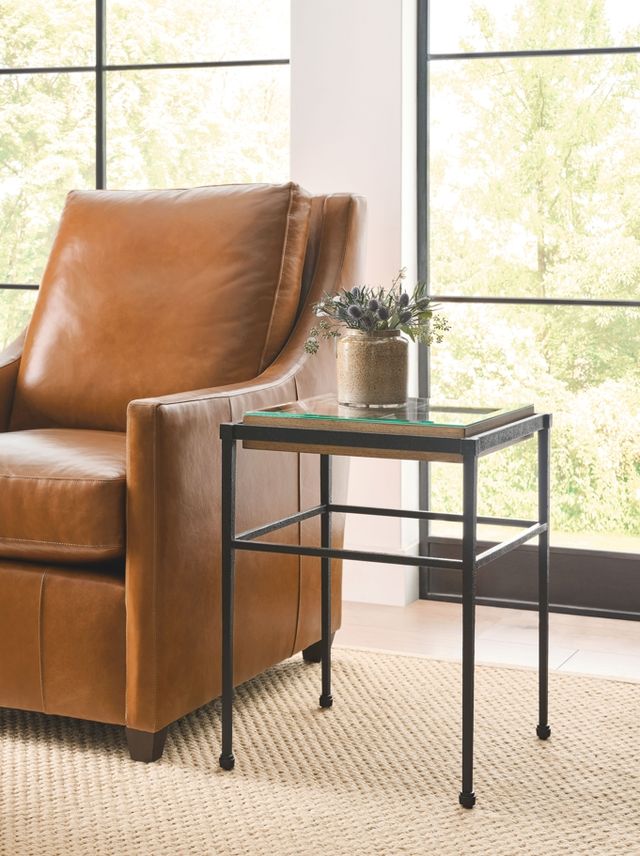
Shape is a traffic and safety decision as much as a style one.
• Square: The classic choice for flanking a sofa, with the most usable surface area per footprint.
• Rectangular: Best in a narrow gap between a sofa and a wall, or tucked behind the arm of a sectional.
• Round and oval: The right call for tight walkways and homes with small children, because there is no corner at toddler head height.
• Drum and pedestal: A single central base means no legs to catch a foot or a vacuum, which suits high-traffic corners.
Matching Shape to Layout
• Sofa plus two chairs: A matched pair flanking the sofa, plus one small table shared between the chairs.
• Sectional with a chaise: One table at the open end, low enough to keep sightlines clear across the corner.
• Small apartment living room: A single round table, or nesting tables that expand only when guests arrive.
• Open-concept great room: Tables with visual weight on all sides, since they are seen from the kitchen and the dining area as well as from the sofa.
• Reading corner with a recliner: One low, narrow table on the side you actually reach with, cleared of the footrest path.
Nesting tables deserve a specific mention. They solve the entertaining problem better than any other configuration, giving one small footprint most of the time and three surfaces when there are six people in the room.
Rugs, Outlets, and Safety
Either put all the legs of a table on the rug or all of them off it. A table with two legs on and two legs off will rock, and no amount of felt pads fixes it. Check outlet placement before you settle on a position, since a lamp and a charger both need power and a cord stretched across a walkway is a hazard. In homes with pets or young children, favor rounded corners, wide stable bases and pieces heavy enough not to tip when a toddler pulls up on the edge.
Before buying, outline the footprint on the floor with painter’s tape. Live with the tape for two days and walk the room normally. If you clip the tape line with your foot on the way to the kitchen, the table is too big or in the wrong spot, and you found that out for the cost of a roll of tape.
Read More: How to Choose a Long-Lasting White Sectional Sofa | Top Features to Look for in a Sectional Couch with Recliner
Matching End Tables to Your Decor Style
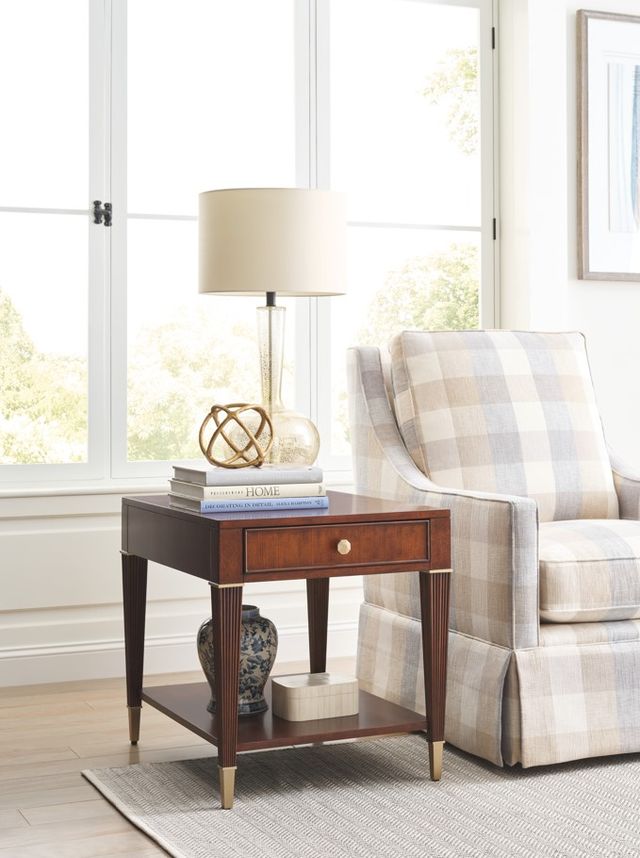
Style is where most people start and where the fewest hard rules exist. Here is what to look for in each direction.
• Modern and minimalist: Clean straight lines, flat fronts, hidden or integrated hardware, matte or low-sheen finishes, and thin profiles.
• Mid-century modern: Tapered legs, often splayed slightly outward, warm walnut tones, rounded edges and slim proportions.
• Farmhouse and rustic: Chunky turned or square legs, visible grain, distressed or dry finishes, plank tops and simple bin or cup pulls.
• Industrial: Metal frames with wood tops, exposed fasteners, blackened or gunmetal finishes and unfussy rectangular shapes.
• Traditional: Turned legs, molded edge details, richer wood tones, brass hardware and more decorative profiles.
• Coastal: Light wood tones, painted finishes, woven textures and open airy bases.
• Transitional: The blend most homes actually have, with simple shapes, moderate detail and finishes that read as neither ornate nor severe.
Do They Have to Match?
No, and the fully matched three-piece set is no longer the default approach. The modern method is coordination rather than duplication: pick a finish tone family, a wood undertone or a metal family and repeat it across pieces that are not identical. Two different end tables in the same warm brown undertone, with a coffee table in a related tone, reads as more considered than a boxed set does.
Mixing works when something repeats. Echo the metal finish of a table base in a lamp, a frame or a curtain rod, or repeat a leg shape across two otherwise different pieces. Mixing fails when nothing repeats and every piece pulls in its own direction, or when two wood tones sit in the same room with clashing undertones, one cool gray-brown and one orange-red.
Finish Against Flooring and Walls
Contrast when the floor is dark and you want the furniture to read as separate, and blend when the room is small and you want it to feel calm. The one combination worth avoiding is a wood tone that is close to your flooring but not the same, since near-misses look accidental in a way that either matching or clearly contrasting does not.
A three-point coordination checklist to carry into a showroom:
1. Undertone: Is the finish warm, cool or neutral, and does it agree with the largest wood surface already in the room?
2. Leg or base shape: Does it echo something else in the room, whether that is a taper, a turn, a block or a pedestal?
3. Finish sheen: Matte, satin or gloss, and is it consistent with the other case pieces you already own?
Read More: 6 Stylish Living Room Table Sets for Augusta Homes | How to Choose a Dining Table Set for Six
Storage, Features, and Everyday Function Worth Paying For
Go back to that two-minute audit list. The configuration you need is written on it.
• Open shelf: Books, magazines, a basket, a decorative object. Everything on it is visible, so it works only if what you store looks acceptable.
• Single drawer: Remotes, chargers, coasters, a notepad. The most useful configuration for most living rooms.
• Two drawers: The same plus overflow, and the choice when the room has no other small storage.
• Cabinet door: Larger and taller items, board games, a router, speaker equipment.
• Lift-top: A work or eating surface that rises to a comfortable height, with storage underneath.
Features That Matter Now
• Integrated USB ports and outlets, which remove a cord run across the floor.
• Wireless charging surfaces, useful only if the phone case is compatible.
• Cord management channels, which are the difference between a tidy lamp cord and a visible loop.
• Casters, for tables that move between seats when guests arrive.
• Adjustable or swivel tops, which turn a side table into an occasional work surface.
Quality Signals You Can Check in Person
• Joinery at the corners, where dovetailed or doweled construction outlasts staples.
• Drawer glides, which should run smoothly and stop cleanly rather than sticking or dropping.
• Stability when you nudge the top with a hip, since a table that rocks in a showroom will rock forever.
• Tabletop finish quality, checked by looking across the surface at a low angle for waves and thin spots.
• Leveling feet, which matter enormously on the uneven floors common in older homes.
• Weight capacity, since a heavy ceramic lamp, a bookshelf speaker and a stack of hardcovers add up faster than people expect.
Surface care is the other half. Heat from a lamp base, condensation from a cold glass and sunlight all attack finishes over time. A tray under drinks and a felt pad under a lamp solve most of it, and a protective topcoat is worth asking about on any piece going next to a window.
Give any table a one-minute inspection in the showroom: open and close every drawer twice, press down on one corner of the top, look across the finish at an angle, tip it very slightly to check the base, and put your hand under the top to feel whether there is a real frame or just a panel.
How to Style an End Table Without Making It Look Cluttered
The working principle is simple: leave roughly half the top clear. A styled table that has nowhere to set a drink has failed at its actual job, and everything you place there is competing with a glass of water.
The core elements, and you rarely need all of them at once:
• A lamp scaled to the table, which is usually the tallest object.
• A small plant or a stem of greenery for something living.
• One or two books, stacked flat, not a leaning tower.
• A small tray to corral remotes, coasters and a phone.
• One sculptural or personal object with some visual weight.
Vary the heights so your eye moves rather than scanning a flat line, and vary the shapes so a round object sits near a square one. Grouping in odd numbers works because three objects create a triangle your eye travels around, while four tend to line up.
Lamp Scale
The lamp shade should be narrower than the tabletop, generally by a couple of inches on each side, so the shade does not hang over the edge. For reading, the bottom of the shade should sit near eye level when you are seated, which puts light on the page rather than in your eyes.
What Should Not Live There Permanently
• Loose charging cables, which belong in a drawer with a cord pass-through or coiled in a small box.
• Mail piles, which belong in an entry tray rather than on a surface you use every evening.
• Stacks of remotes, which belong in a small tray or a drawer.
• Empty glasses and mugs, which is a habit problem solved by a tray that makes carrying four at once easy.
• Seasonal decor left up past its season, which is what makes a styled table look tired rather than refreshed.
Refreshing does not require new furniture. Swap the stem of greenery, change the book on the stack, move the tray to the other table, or change one object with the season. Five minutes, no delivery truck.
End Table Materials Compared: Wood, Glass, Metal, and Stone
| Material | Style Fit | Durability and Stability | Everyday Maintenance | Kids and Pets | Best Use |
|---|---|---|---|---|---|
| Solid wood | Traditional, farmhouse, mid-century | Highest, heavy and very stable | Dust and occasional polish, refinishable | Good, though it dents and shows water rings | A room you intend to keep the piece in for decades |
| Engineered wood with veneer or laminate | Modern, transitional, budget-conscious | Good, lighter and less stable than solid | Wipe clean, cannot be refinished | Very good, laminate resists spills well | A first living room or a room that will change soon |
| Tempered glass | Modern, minimalist, small spaces | Strong but tips more easily on a light base | Shows every fingerprint, needs frequent cleaning | Fair, choose rounded corners and a heavy base | A small room where visual openness matters most |
| Metal | Industrial, modern, mixed-material | Very high, resists dents and moisture | Wipe clean, watch for scratches on a finish | Very good, hard to damage | A family room that takes real abuse |
| Stone or marble | Traditional, luxury, contemporary | Highest weight, extremely stable | Sealing required, stains from oil and acid | Fair, stains are the risk rather than breakage | A formal room where drinks are used with coasters |
| Woven rattan or cane | Coastal, boho, transitional | Moderate, light and easy to move | Vacuum the weave, keep out of prolonged damp | Fair, cats find woven surfaces interesting | A sunroom or a light, airy sitting area |
| Mixed builds, wood top on metal frame | Industrial, modern, transitional | High, metal frame with a warm surface | Two surfaces to care for, each on its own terms | Very good, sturdy base with a repairable top | A room that wants warmth without a heavy all-wood look |
Read the table by your household first and your style second. A busy family room with kids and dogs is best served by metal or engineered wood with a durable laminate top, where spills and knocks do not become permanent. A formal sitting room can carry stone or solid wood, since drinks there are occasional and coasters actually get used. A small apartment benefits from glass or a slim metal frame, because you see through them and the room reads larger. And a sunny room is the one place to be careful, since prolonged direct sunlight fades wood finishes unevenly and dries out woven materials over time.
End tables solve genuine daily problems, but they also take floor space, cost money and add another surface to clean. The right decision comes from your room’s actual traffic and habits rather than from a rule about what a living room should contain. Weigh both sides before you buy a pair out of reflex.
Pros
They put a lamp where you need light
Reading light beside a seat is the job no floor lamp does quite as well, and a table is what makes it possible.
They stop the sofa arm from becoming a table
Drink rings, dropped remotes and slid-off phones all trace back to having nowhere else to set anything.
A pair anchors a seating group
Two tables flanking a sofa create symmetry that makes a room look intentionally arranged rather than assembled.
Storage options hide the clutter
A single drawer swallows the remotes, the chargers and the coasters that otherwise live in view permanently.
They add material and texture variety
A wood or stone surface breaks up a room dominated by upholstery, which is what keeps a seating group from reading as one large mass.
Cons
They consume walkway space
In a small or narrow room, a table at each end can drop a main path below comfortable clearance.
They collect what you set down
An open top with no tray or drawer becomes a permanent landing zone for mail, cables and cups within a week.
What Augusta and Aiken Homes Do to an End Table
Humidity is the local variable that decides how these pieces age here, and it works in both directions. The CSRA runs humid from spring into fall, then homes run heated and dry through the winter, so solid wood in an Augusta or Aiken living room expands and contracts more across a year than the same piece would in a stable climate. That is why drawers that glide easily in February start sticking in July, and it is a normal wood movement issue rather than a defect. Add the region’s sunlight, which is intense through the tall south-facing windows common in newer Evans and Grovetown construction, and finishes on a table beside a window fade faster than the same finish across the room. Then there are the sunrooms and screened porches that so many homes here have, where people put living room furniture that was never built for that swing in temperature and moisture.
• Choose engineered wood with a quality veneer or laminate for a sunroom or screened porch, since solid wood moves most where humidity swings hardest.
• Rotate a table’s position or use a window film on a south-facing wall if the finish is a dark stain, which shows fading the fastest.
• Look for drawers with a little side clearance rather than a perfectly tight fit, because a tight-tolerance drawer is the one that binds in August.
• Keep the room’s humidity in a moderate range year round, which does more for solid wood furniture than any polish.
• Use leveling feet or shims on the heart pine and older hardwood floors common in Summerville and downtown Augusta homes, where floors rarely sit dead flat.
• Pick a stone or metal top for a screened porch table, since neither one cares about the moisture that will warp a wood surface.
• If your guest rooms and living areas get rented out during Masters week, favor sealed, wipeable surfaces and stable bases over delicate finishes.
Read More: Furniture Stores Augusta GA: Visit Kelley | Furniture Shopping in Aiken, SC: A Local Buyer’s Guide
Standout End Tables Available at Kelley Appliance Center
The pieces below cover the range this guide walked through, from square tables built for flanking a sofa to a low chairside chest with real storage and a coffee table to coordinate with. Match them to the seating measurements you took rather than to a photo, and remember that finish tone matters more than exact matching. Come see them against real sofas in our showroom, where you can check the height relationship in about ten seconds.
American Drew® Chastain Woodfield Brown Square End Table
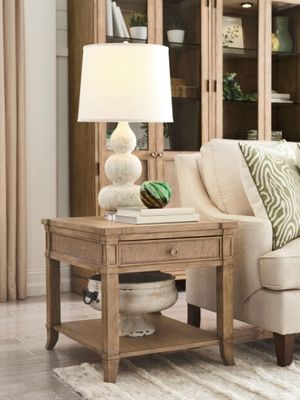
The square shape is the classic sofa-flanking format, and it earns that reputation by giving you the most usable surface for the footprint it occupies. A lamp, a drink and a book all fit without crowding, which is exactly what a primary seating position needs. The woodfield brown finish is a warm mid-tone, which is the easiest range to coordinate with existing furniture because it plays well with both cooler grays and warmer leather. For a traditional or transitional living room where you want a matched pair at either end of the sofa, start here. Come check the height against your sofa arm in our showroom.
Top Features
• Square top: Maximum usable surface for the floor space it takes, which is why it is the standard choice beside a sofa.
• Woodfield brown finish: A warm mid-tone that coordinates easily with existing wood and upholstery rather than demanding a full match.
• American Drew construction: A case goods maker with a long record in living room and dining furniture.
• Pairs naturally: Buy two to flank a sofa symmetrically, or one for an asymmetrical layout.
American Drew® Milan Avery Gray Tone End Table
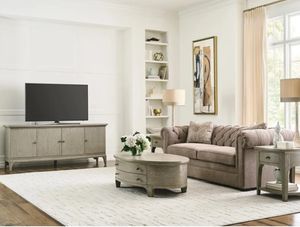
Gray tone is the finish to reach for when the room already has cool undertones, whether that is a gray sectional, cool-toned flooring or a painted wall in the blue-gray family. Coordinating by undertone rather than buying a matched set is exactly the approach this guide recommends, and a gray-toned table is one of the easiest pieces to build that coordination around. It suits a modern or transitional room, and it works particularly well in a smaller space where a dark wood tone would read heavy. For an apartment or a condo living room, this is a natural fit. See how it reads next to your fabric samples.
Top Features
• Gray tone finish: A cool-undertone piece that coordinates with gray upholstery and cool flooring without competing with it.
• Transitional styling: Simple enough for a modern room and warm enough for a traditional one.
• Visually light: Reads less heavy than a dark wood tone, which helps in smaller living rooms.
• Milan collection design: Part of a coordinated group if you want related pieces elsewhere in the room.
American Drew® Summit Canyon End Table with Basalt Base
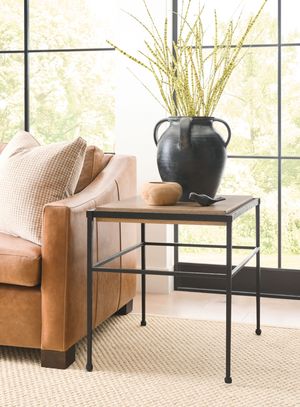
This is the mixed-material option from the table above, brought into a real piece. A stone basalt base gives you weight and stability where it matters most, at the floor, which is what keeps a table from rocking when someone sets down a heavy lamp or a toddler pulls up on the edge. The canyon top brings the warmth that an all-stone piece would lack. That combination suits a family room where stability is a genuine requirement rather than a preference. It also works in a contemporary room that needs one piece with real material presence. Come feel the weight of the base for yourself.
Top Features
• Basalt stone base: Substantial weight at floor level, which is the most effective way to prevent tipping and rocking.
• Mixed-material construction: Stone stability paired with a warmer top surface, so the piece reads solid without reading cold.
• Contemporary Summit styling: A current design direction that suits open-concept and transitional rooms.
• Stable on uneven floors: A heavy base is more forgiving on the older wood floors common in the area.
American Drew® Summit Glass Top End Table with Basalt Base
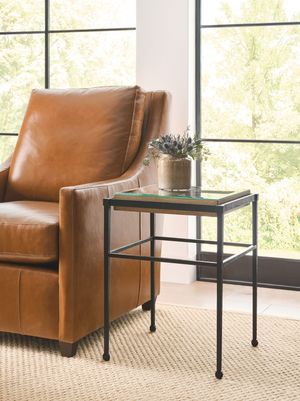
Glass is the material to choose when a room is small and you want the eye to travel through the furniture rather than around it, and pairing it with a basalt base solves the one real weakness glass tables have, which is instability on a light frame. You get the visual openness without the wobble. This suits an apartment living room, a narrow sitting area, or any space where a solid wood table would make the corner feel crowded. Plan on wiping it more often than a wood top, since glass shows every fingerprint. Come see how much lighter it makes a corner feel.
Top Features
• Tempered glass top: Visually open, which makes a small room read larger than a solid surface does.
• Basalt stone base: The weight that glass tables usually lack, keeping the piece stable and hard to tip.
• Small-space friendly: The right choice for apartments, condos and narrow sitting areas.
• Coordinates with the Summit group: Related to the canyon-top version if you want two different tops on the same base language.
Hammary® Addison Greenhill Brown Rectangular End Table
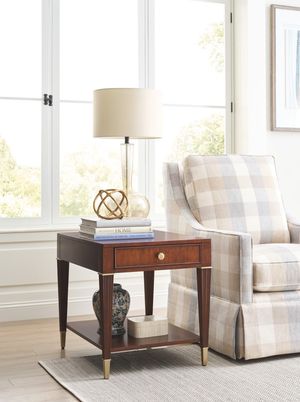
Rectangular is the shape for the spot a square table will not fit, which is usually a narrow gap between a sofa and a wall, or the position behind the arm of a sectional. The longer, shallower footprint gives you real surface area without pushing out past the front of the seating, which is the depth rule this guide flagged as easy to break. Hammary builds occasional furniture as its specialty rather than as a sideline, and the greenhill brown finish is a versatile mid-tone. For a sectional layout or a tight side gap, measure and then look here. Bring your wall-to-sofa measurement with you.
Top Features
• Rectangular footprint: Fits narrow gaps and behind-the-arm placements where a square table will not.
• Greenhill brown finish: A mid-tone brown that coordinates broadly rather than committing the room to one direction.
• Hammary occasional specialty: A maker focused specifically on end tables, coffee tables and accent pieces.
• Sectional-friendly proportions: Depth that respects the seating line instead of protruding into the walkway.
American Drew® Chastain Woodfield Brown Chairside Chest
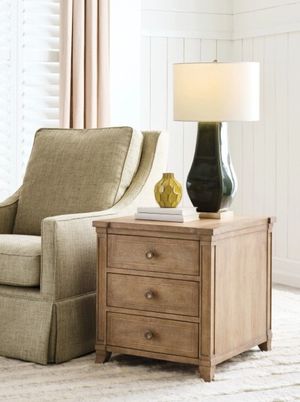
If the two-minute audit turned up remotes, chargers, coasters, notepads and reading glasses, this is the piece that answers it. A chairside chest gives you drawer storage in a footprint narrow enough to fit beside a chair or at the end of a sofa, which is a much better answer than an open shelf when the things you set down are not display objects. It shares the Chastain woodfield brown finish with the square end table above, so the two coordinate directly if you want one of each. For a reading corner beside a recliner, this is the practical choice. Open the drawers in our showroom and feel the glides.
Top Features
• Drawer storage: Hides remotes, cables and small items instead of leaving them permanently on display.
• Narrow chairside footprint: Sized to fit beside a chair or recliner where a full end table would crowd the space.
• Matches the Chastain square end table: The same woodfield brown finish, so mixing the two reads as intentional.
• Vertical proportions: More storage per square foot of floor than a low open-shelf table offers.
American Drew® Chastain Woodfield Brown Rectangular Coffee Table
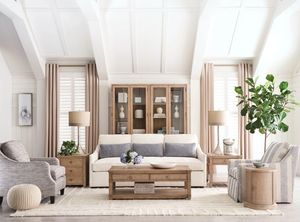
A coffee table is the piece that ties an end table decision together, since the two are seen at the same time from every seat in the room. This one shares the Chastain woodfield brown finish with the square end table and the chairside chest, which gives you a coordinated group without the rigidity of a boxed matched set. The rectangular shape is the standard for a sofa-facing arrangement, leaving room to walk on both long sides. If you are furnishing a living room from scratch rather than adding one piece, starting with a coordinated finish family makes every later decision easier. Come see all three pieces together on our floor.
Top Features
• Rectangular coffee table format: The standard proportion for a sofa-facing seating group with walkways on both sides.
• Coordinating woodfield brown finish: Shares a finish family with the Chastain end table and chairside chest.
• Central anchor for the group: Sets the finish tone the surrounding pieces coordinate to.
• American Drew case construction: Built by a maker with a long history in living room case goods.
Finding the Best End Tables for Living Room Comfort and Style
Size to the seating first, since a tabletop level with the sofa arm is what makes the piece usable at all. Choose a material that matches how your household actually lives, whether that means laminate in a family room or stone in a formal sitting area. Then let style and storage narrow the final choice, coordinating by finish tone rather than hunting for a matched set. That order turns a frustrating search into three straightforward decisions.
Come measure against the real thing. Visit Kelley Appliance Center to see finishes, heights and proportions beside actual sofas and chairs, or contact our team for help pairing pieces you already own with something new. Our staff knows these furniture lines rather than reading a spec sheet back to you, and our crews handle delivery and placement in the room where the piece is going, with local service and support after the sale. Getting that corner right is what makes the whole room finally feel finished.
Frequently Asked Questions about End Tables for Living Room Spaces
An end table beside a sofa should sit level with the top of the sofa arm or up to about two inches below it, which usually falls in the 22 to 26 inch range. Measure from your floor to your own armrest rather than trusting an average, since sofa arm heights vary widely between styles.
End tables do not have to match each other or the coffee table, and coordinating by finish tone, wood undertone or metal family generally looks more considered than a boxed matched set. The one rule worth keeping is repetition, so echo an undertone, a leg shape or a metal finish somewhere else in the room to tie the pieces together.
In a small living room, look for a table roughly 16 to 20 inches wide with a round or drum shape, since a round top removes corners from a tight walkway and reads visually lighter. Glass tops and slim metal frames also help, because seeing through the furniture makes the floor area appear larger than a solid piece does.
Metal and engineered wood with a durable laminate top hold up best in homes with kids and pets, since both resist spills, scratches and knocks without permanent damage. Solid wood is durable but shows dents and water rings, while glass and stone are better suited to rooms where drinks are used with coasters.
With a sectional, place the table at the open end and choose a low profile that keeps sightlines clear across the corner of the seating group. With a recliner, use a lower and narrower table positioned to clear both the extended footrest in front and the reclined back behind, since a standard-height table beside a recliner is in the way twice a day.
End tables with drawers are better when the items you set down are remotes, chargers, coasters and paper, because a drawer hides them and an open shelf displays them. Open shelves work well when you want to store books, baskets or decorative objects that look good in view, so the right choice depends on what your audit of the sofa arm actually turns up.
Why Trust Kelley?
For over 50 years, Kelley Appliance has been the trusted, family-owned source for home needs in the Central Savannah River Area. When you shop with us, you're not just a customer; you're our neighbor. We take pride in providing a hassle-free experience built on honesty and integrity.
Recognized as the #1 Appliance Store, our Kelley Augusta, GA location specializes in offering a wide selection of top-brand appliances at competitive prices. Our Aiken, SC, location expands on this, providing both appliances and home furniture to meet all your home furnishing needs. With fast delivery and flexible financing options, experience the Kelley difference and see why generations of families trust us to make their home a true haven.
Learn more: