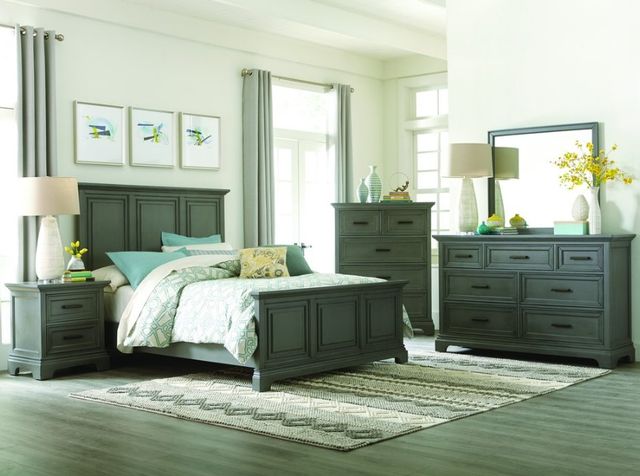
The dresser came from a grandparent’s house in a reddish oak. The nightstand was a discount-store purchase in gray laminate, and it is two inches shorter than the mattress, so the lamp sits at the wrong height for reading. The bed frame is a third wood tone entirely. None of it was chosen together, and the proof is the chair in the corner holding a stack of folded sweaters that never had a drawer to live in. That corner chair is the real reason people start shopping bedroom sets, because it is not a decorating problem at all. It is a storage problem wearing a decorating problem’s clothes.
Here is the part that makes this easier than it looks. A coordinated bedroom is a short list of decisions made in the right order, and most shoppers make them backwards by picking a style first and discovering the clearance problem after delivery day. At Kelley Appliance Center, our team walks people through the order that actually works, which is what each piece count includes, how to size a group to your room and your doorways, six coordinated styles worth copying, how wood tones and finishes stay matched over years, which storage configurations hold the most in the least floor space, and how to mix a few pieces without losing the pulled-together look.
See Bedroom Finishes Side by Side Before You Buy
Our team helps you compare wood tones, piece counts, and room layouts in person, then handles delivery and setup so everything arrives placed and ready. Bring your room measurements and we will do the math with you.
Explore bedroom setsKey Takeaways
- The bed counts as one piece: A 5-piece set means bed, nightstand, dresser, mirror, and chest, even though the bed itself arrives as a headboard, footboard, and rails, and piece counts are not standardized between manufacturers.
- Clearance decides the configuration, not square footage: Plan 24 to 30 inches of walkway beside and at the foot of the bed and 30 to 36 inches in front of a dresser so drawers open fully, then choose the piece count that fits what is left.
- Undertone matters more than color name: Two pieces can both be called gray and still clash, so match warm against warm and cool against cool, and confirm it under the same light rather than on a screen.
- A collection beats a boxed set: Building from one collection gives you the matching finish of a set with the freedom to skip the pieces your room cannot hold, which is how a room stays coordinated without looking like a catalog page.
What Bedroom Sets Include: 3-Piece, 4-Piece, 5-Piece, and 6-Piece Explained
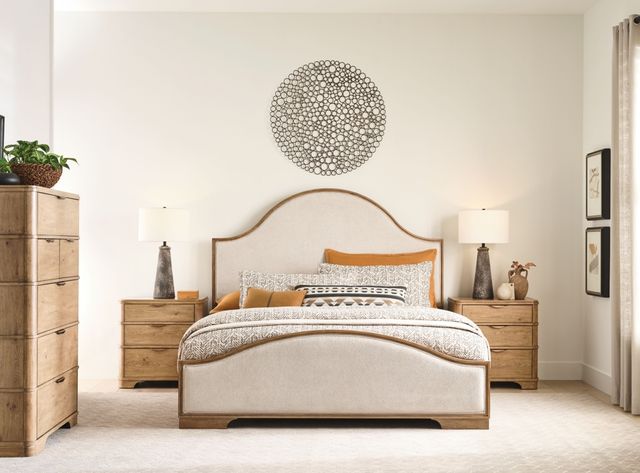
A bedroom set is a group of coordinated pieces designed and finished together, and the number in the name tells you how many pieces come in the group. The bed counts as one single piece even though it ships as a headboard, footboard, and side rails, which is the detail that surprises the most shoppers when the boxes arrive.
Here are the standard configurations, from smallest to largest.
- 3-piece: usually a bed plus two nightstands, or a bed, one nightstand, and a dresser. Common in guest rooms and smaller primary bedrooms.
- 4-piece: bed, nightstand, dresser, and mirror. The most popular starting point for a queen bedroom set.
- 5-piece: bed, nightstand, dresser, mirror, and chest. This is the answer to what a 5 piece bedroom set includes, and the chest is what makes it work for two people sharing a closet.
- 6-piece: bed, two nightstands, dresser, mirror, and chest. A symmetrical layout for a larger primary suite, and the configuration most often paired with king bedroom sets.
The Words Shoppers Mix Up
Furniture vocabulary is not intuitive, and getting it wrong costs you drawer space you assumed you were buying.
- Dresser: wide and low, with drawers side by side. Built to sit under a mirror or a television.
- Chest of drawers: tall and narrow, with drawers stacked vertically. Same storage volume in far less floor space.
- Armoire: a tall cabinet with doors, often mixing hanging space with drawers. Useful in older homes with shallow closets.
- Panel bed: a headboard and footboard connected by rails, usually with a flat or framed panel design. Needs a foundation or slats depending on the model.
- Sleigh bed: a panel bed with a curved, scrolled headboard and often a matching footboard. It reads more traditional and takes more length.
- Upholstered bed: a padded, fabric-covered headboard, sometimes with an upholstered footboard or rails. The softest option to lean against.
Mirrors deserve their own note. Some sets include the mirror in the price, some list it as a separate line item, and some sell a dresser and mirror together as a two-piece pairing. Read the description rather than the photo.
The information most product pages bury is that piece counts are not standardized between manufacturers. One brand’s 5-piece includes a chest, another’s swaps in a second nightstand, and a third counts the mirror separately. Before you order anything, confirm the exact pieces included, whether the mirror is attached or freestanding, and whether the mattress and foundation are part of the price. They almost never are.
Read more:
How to Size Bedroom Sets to Your Room Layout
Start with the mattress, because everything else in the room is planned around it. These are the standard footprints in inches:
- Twin: 38 by 75
- Full: 54 by 75
- Queen: 60 by 80
- King: 76 by 80
- California king: 72 by 84
A headboard adds roughly 4 to 8 inches of depth beyond the mattress, and a footboard adds a few more at the other end. So a queen bed is realistically an 85 to 90 inch run of floor, not 80.
The Clearance Numbers That Prevent Regret
Square footage does not tell you whether a set fits. Walkways do.
- Leave 24 to 30 inches of clear walkway on each side of the bed and at the foot, so two people can pass without turning sideways.
- Leave at least 30 to 36 inches in front of a dresser or chest so drawers pull out fully and you can stand in front of them.
- Keep nightstand tops near mattress height, within a couple of inches either way, so a lamp and a glass of water are actually reachable.
- Keep tall chests off walls with low windows or a sloped ceiling. A chest that blocks a window costs you daylight you cannot get back.
Measure the Route, Not Just the Room
This is the step almost every online-only checkout skips, and it is the one that turns delivery day into a return. Before you commit to a large set, measure the entry doorway width with the door open, every hallway width, every corner the pieces have to turn, and the stairwell landing including the handrail. A dresser that fits the wall perfectly is worthless if it will not clear the turn at the top of the stairs. Kelley Appliance Center handles delivery and setup, so the crew confirms the route and assembles pieces in position rather than leaving boxes in the driveway.
Quick recommendations by room size:
- A 10 by 10 room comfortably takes a 3-piece or 4-piece set with a queen bed, and a chest instead of a second nightstand if storage is tight.
- A 11 by 12 room supports a 4-piece or 5-piece set with a queen, with room for the dresser on the long wall.
- A 12 by 14 room or larger supports a full 6-piece set with a king, including two nightstands and both a dresser and a chest.
Bedroom Sets Compared: Piece Counts, Room Size, and Storage at a Glance
Find the row that matches your room, then read across before you decide on a configuration.
| Set Configuration | Pieces Included | Best Bed Size | Minimum Room Size | Total Drawer Storage | Best For |
|---|---|---|---|---|---|
| 3-Piece Set | Bed plus two nightstands, or bed, nightstand, dresser | Twin, full, or queen | About 10 by 10 | Low, roughly 4 to 8 drawers | Guest rooms and tight primary bedrooms |
| 4-Piece Set | Bed, nightstand, dresser, mirror | Queen | About 10 by 12 | Moderate, roughly 7 to 10 drawers | One person or a couple with good closet space |
| 5-Piece Set | Bed, nightstand, dresser, mirror, chest | Queen or king | About 12 by 12 | High, roughly 12 to 15 drawers | Couples sharing one small closet |
| 6-Piece Set | Bed, two nightstands, dresser, mirror, chest | King | About 12 by 14 | Highest, roughly 14 to 18 drawers | Primary suites with symmetrical layouts |
Style families compare on a different set of terms, so here they are side by side.
| Style Family | Typical Wood Tone or Finish | Signature Detail | Room Vibe |
|---|---|---|---|
| Modern Farmhouse | Warm oak, whitewash, weathered gray | Plank fronts and simple black hardware | Relaxed and welcoming |
| Coastal Light Neutral | Driftwood, sand, soft white | Airy frames and woven texture | Bright and calm |
| Mid-Century Modern | Walnut and honey brown | Tapered legs and slim profiles | Clean and warm |
| Classic Traditional | Cherry, espresso, rich brown | Molding, turned posts, brass pulls | Formal and settled |
| Upholstered Glam | Pale neutral fabric with metallic accents | Tufted or channel-stitched headboard | Soft and dressy |
| Rustic Industrial | Dark oak and blackened metal | Visible grain and iron hardware | Grounded and bold |
Read those two tables together and a pattern shows up. The 5-piece configuration delivers the most drawer storage per square foot of floor space, because the chest stacks its capacity vertically instead of spreading it along a wall. The 6-piece is the better choice when the room is wide enough for symmetry, since two matching nightstands do more for a coordinated look than any other single upgrade. And if your room is under about 120 square feet, a 4-piece with a chest substituted for the second nightstand almost always beats forcing a larger group into the space.
6 Bedroom Sets That Create a Cozy, Coordinated Look
Style is where the room stops being furniture and starts being a place you want to be. These six directions cover the range most shoppers are choosing between, and each one names the mistake that undoes it.
1. Modern Farmhouse
Low panel bed with a plank-look headboard, warm oak or whitewashed finish, and simple black or matte iron hardware. Legs are chunky and squared rather than delicate. Finish it with a waffle-weave quilt, a linen duvet, and one woven basket at the foot of the bed. It suits a primary suite in a newer home and reads well in a guest room. The common mistake is going too gray, which drains the warmth out of the look and leaves the room feeling cold instead of cozy.
2. Coastal and Light Neutral
Light driftwood, sand, or soft white finishes on a low-profile bed, often with an open or slatted headboard. Hardware disappears into the piece rather than announcing itself. Layer in white bedding, a jute rug, and one blue or sage accent. This is the best direction for a small apartment bedroom or a north-facing room that never gets much daylight. The mistake is themed decor, since anchors and rope on the walls turn a calm room into a gift shop.
3. Mid-Century Modern
Walnut or honey-toned wood, slim horizontal lines, tapered legs, and a headboard with no footboard at all. Drawer pulls are often recessed or a narrow bar. Pair it with a low-pile rug, a globe pendant, and bedding in mustard, rust, or olive. It fits a teen room, a young professional’s first place, or a primary bedroom in a home with clean lines. The mistake is buying every piece in the same era, which stops being a room and starts being a museum display.
4. Classic Traditional
Cherry, espresso, or rich brown wood with molding detail, turned posts, and antique brass or bronze pulls. Sleigh beds and tall poster beds live here. Add a patterned rug, heavier drapery, and layered bedding with a coverlet and shams. This is the direction for a formal primary suite in an older home with real trim work. The mistake is scale, since a heavy traditional set in a small room with low ceilings makes the walls feel like they are closing in.
5. Upholstered Glam
A tall upholstered headboard in a pale neutral fabric, tufted or channel stitched, paired with wood or mirrored case pieces and polished metal hardware. Bedding is silky and layered, lighting is warm, and there is usually a bench at the foot of the bed. It suits a primary suite where the bedroom doubles as the place you actually relax. The mistake is pairing a high-gloss glam set with heavily distressed or rustic flooring, because the two finishes fight each other and neither wins.
6. Rustic Industrial
Dark oak or reclaimed-look wood with visible grain, blackened metal accents, and heavy squared frames. Storage pieces often show strap hardware or pipe-style pulls. Ground it with a leather bench, a flat-weave rug, and dark neutral bedding. It works in a loft, a basement bedroom, or a room with exposed brick or beams. The mistake is overloading a small room with a dark rustic set, which visually shrinks a space that was already tight.
Wood Tones, Finishes, and Materials in Bedroom Furniture Sets
What a piece is made of decides how long it stays worth owning. There are three tiers, and the price differences between them are honest.
Solid hardwood is the top tier. It handles moves, refinishing, and decades of drawer cycles, and a well-built solid wood bedroom furniture group can stay in service 15 to 20 years or longer. Hardwood with a quality veneer over an engineered core sits in the middle and is not a compromise the way people assume, since veneer over a stable core actually resists warping better than a wide solid panel in some designs. Laminate and particleboard occupy the entry tier, where the surface is a printed film. It looks fine on day one, but edges chip, and a soaked drawer bottom swells and never recovers.
Reading Finishes and Undertones
Finishes run along a predictable range. Light finishes include natural oak, whitewash, and driftwood. Mid tones cover honey, walnut, and gray-brown. Dark finishes run through espresso and near-black.
The coordination rule is simpler than most guides make it. Match undertone, not color name. Warm finishes carry yellow, orange, or red under the surface. Cool finishes carry gray, blue, or green. Two pieces can both be described as gray and still clash badly if one leans warm and the other leans cool. To read undertone in your own room, hold a sample against your flooring and your window trim in daylight, then again under lamp light at night. Whatever direction your floor leans is the direction the furniture should lean, unless you are deliberately going for contrast.
What to Inspect Before You Buy
These are the quality signals you can check with your hands in about ninety seconds.
- Dovetail joinery at the drawer corners, which holds under load far longer than staples and glue.
- Full-extension drawer glides, so the back six inches of the drawer are usable instead of decorative.
- Soft-close glides that stop a drawer from slamming, which matters in a bedroom more than anywhere else in the house.
- Dust panels between drawers, a sign the maker did not skip the parts nobody sees.
- Weight and rigidity, since a case piece that flexes when you push a top corner will loosen over time.
- Finish consistency across the top, the sides, and the drawer fronts under strong light.
One practical note worth handling before delivery day: most solid wood furniture warranties exclude damage caused by humidity swings, and manufacturers generally want the room held somewhere around 35 to 55 percent relative humidity, because dry winter air shrinks panels and causes the hairline splits that show up in January. A humidifier in the bedroom during heating season is cheaper than a warranty claim that gets denied.
Upholstered headboards follow different rules. Look at the fabric’s abrasion rating and its cleaning code the same way you would on a sofa, because a headboard collects hair oil exactly where people lean. Tufting creates depth and a dressier mood but catches dust in the buttons. Channel stitching runs cleaner vertical lines, wipes down faster, and reads more current. Either way, a performance fabric on a headboard is worth the small premium.
Bedroom Sets Pros and Cons: What to Weigh Before You Commit
Buying a coordinated group and buying pieces one at a time are both legitimate paths, and the right one depends on your room shape and how fast you need the room finished. Read these against your actual space rather than an ideal one.
Pros
Finish and scale are guaranteed to match:
Every piece comes from the same design program and the same finish specification, so the dresser and the bed will not read as two different browns under your bedroom light.
Bundled pricing beats piecemeal buying:
A grouped purchase almost always costs less than acquiring the same pieces separately over a year, and you avoid the price increases that land between purchases.
One delivery and one setup appointment:
Everything arrives together, gets assembled and placed in one visit, and you are not living around a half-finished room for months.
Decisions get made once:
Choosing a group settles bed size, storage capacity, and style in a single sitting instead of restarting the search every time you add a piece.
Collections stay available longer than you think:
Buying into an active collection leaves the door open to add a matching nightstand or bench later, which a one-off piece never allows.
Cons
Less flexibility in odd rooms:
Angled walls, dormers, radiators, and closet doors that swing into the room can make a full group impossible to place, and a set does not let you swap in a narrower piece.
A matched room can read flat:
Without layered textiles, art, and a couple of personal pieces, an all-matching group can look like a showroom vignette instead of a bedroom someone lives in.
The resolution is straightforward. Buy the full group when the room is a standard rectangle, you need it finished now, and you want the storage capacity settled in one decision. Build piece by piece from within one collection when the room has odd angles, when the budget needs to spread out, or when you already own one good piece worth keeping.
Read more:
- Built-In Refrigerator Buying Guide: What to Know Before You Upgrade
- Top Features to Look for in a Sectional Couch with Recliner
Storage-Focused Bedroom Sets: Storage Beds, Dressers, Mirrors, and Chests
Storage is the whole reason that corner chair exists. Here is how the options actually compare.
Storage Bed Choices and Their Trade-Offs
- Under-bed drawers: two to four drawers in the bed’s base. They need 24 to 30 inches of side clearance to open fully, which is the same walkway number from earlier, so they cost nothing extra in floor space if you planned properly.
- Footboard storage: drawers built into the footboard. Great in narrow rooms where side clearance is short, and it does add length at the foot of the bed.
- Bookcase headboard: shelving built into the headboard for books, glasses, and a phone. It replaces a nightstand in tight rooms but adds depth behind the mattress.
- Lift-up platform: the entire mattress deck hinges up over a full-footprint storage cavity. The most volume by far, ideal for seasonal bedding and luggage, and it usually requires a platform slat system rather than a box foundation.
Confirm whether any storage bed uses a slat platform or needs a separate foundation before you order a mattress to go with it. That single question prevents the most common bedroom-delivery surprise.
Dresser Plus Chest Versus One Large Dresser
A dresser, mirror, and chest combination and a single oversized dresser can hold similar amounts, but they use the room completely differently. The dresser mirror and chest set spreads part of the load vertically, so it occupies less wall run and frees a wall for a reading chair or a window. A single long dresser keeps everything at one reachable height, which is better for anyone who does not want to stretch for a top drawer, and it gives you a wide surface for a television or a lamp pair.
Nightstands split the same way. Drawers hide the clutter that accumulates beside a bed. Open shelves keep books visible and cost less. Built-in outlets and USB charging are worth seeking out, because they remove the extension cord that runs under the bed. Larger groups often add a bench or a vanity, and a bench at the foot of the bed is the single best cure for clothes piling on a chair.
Which Clothes Go Where
Organizers have a rule that furniture shoppers rarely hear. Wide, shallow drawers are for flat-folded items laid in a single layer, meaning shirts, folded knits, and workout clothes. Deep drawers are for bulk, meaning sweaters, sweatshirts, and jeans stacked two or three high. A chest solves seasonal storage specifically, because its bottom two drawers can hold off-season bulk that would otherwise eat half a closet in a home built with small closets.
One more thing a mirror does that nobody counts as storage. Hanging it above the dresser bounces daylight back across the room, which makes a darker or smaller bedroom feel noticeably larger and warmer, and that is exactly the cozy and coordinated result you are after.
Matched Versus Mixed: How to Style Bedroom Sets So the Room Feels Warm
Does all bedroom furniture have to match? No. But the rooms that mix successfully are following rules, not winging it, and the fastest path for most people is a middle route: anchor the room with a matched core of two or three pieces, then mix in one or two intentional pieces that were chosen, not inherited.
The rules that make mixing work are short and repeatable.
- Keep undertones consistent. Warm with warm, cool with cool, regardless of how light or dark each piece is.
- Repeat any finish or metal at least twice in the room, so nothing looks like an accident.
- Vary scale rather than style. A tall chest next to a low bed works. A rustic chest next to a glam bed usually does not.
- Let exactly one piece be the visual accent. Two accents cancel each other out.
Then layer the cozy on top, because furniture alone never gets there. Size the rug so it extends at least 18 to 24 inches past the sides and foot of the bed, or run a pair of runners along each side in a tight room. Layer bedding in different weights rather than one heavy comforter. Use warm-temperature bulbs around 2700K on bedside lamps, since cool white light makes a bedroom feel like an office. Add window treatments that soften the walls, and put a chair or a bench where clothes currently land.
Picture the room from the opening. The oak dresser, the gray laminate nightstand, the third-tone bed frame, and the sweater chair. Replace two pieces, not five. A new bed and a matched pair of nightstands in one warm finish immediately give the room a center, and the old oak dresser suddenly reads as an intentional vintage accent instead of a leftover, because now it is the only warm-wood outlier in a room with a clear anchor. The sweater chair becomes a bench with a throw on it. That is a two-piece fix, not a full replacement.
Screens are the enemy of this process. Monitor calibration, room lighting, and photo editing all shift wood tones, and a finish that looks warm walnut on a phone can arrive reading gray-brown. Seeing finishes side by side in the Kelley Appliance Center showroom under one consistent light is the fastest way to confirm undertones match before anything is ordered.
The Collection Clock: Why Timing Changes What You Can Add Later
Furniture makers do not build individual pieces, they build collections, and collections run on a production calendar that most shoppers never see. A collection is designed as a family with one finish specification, one hardware program, and one set of proportions, and pieces are produced in runs. That has two consequences worth planning around. Finish can vary slightly between production runs years apart, the same way paint varies between batches, so pieces bought close together match more reliably than pieces bought far apart. And collections eventually get retired, which means the nightstand you planned to add in three years may not exist then. This is the real argument for buying from within one collection and for asking about availability before you split a purchase across a long timeline.
- Ask which collection a piece belongs to and how long it has been in the line, since a newly introduced collection usually has years of availability ahead of it.
- Ask what other pieces exist in that collection, including ones not on the floor, because the catalog is almost always deeper than the showroom display.
- Buy the pieces you know you want at the same time, so they come from the same production window and the finish is a true match.
- If you must stage a purchase, prioritize the pieces where a finish mismatch would be most visible, which is anything sitting side by side, such as a pair of nightstands.
- Note the collection name and finish name on your receipt, since that is what an order for a matching add-on piece will need later.
- Ask whether a piece is a current line item or a closeout, because closeout pricing is real value when you are not planning to add anything else.
Read more:
- Furniture Stores Augusta GA: Visit Kelley
- Why Kelley's Stands as the Best Appliance Store in Augusta, GA
Featured Bedroom Sets Available at Kelley Appliance Center
None of the pieces below is sold as a boxed set, and that is on purpose. A coordinated room is usually built from within a collection rather than bought as one sealed carton, which is precisely how you get matching finish and scale without ending up with a room that looks generic. The lineup shows how a collection builds: two Vista pieces in the same Hickory Shell finish that handle the storage side of a room, two John Thomas panel beds representing a warm neutral and a cooler contemporary direction, and one American Drew upholstered bed offered in two sizes so you can pick by room dimensions. Bring your measurements and our team will tell you which pieces coordinate and what else exists in each line.
John Thomas Furniture Vista Bedroom 2-Piece Hickory Shell Dresser and Mirror
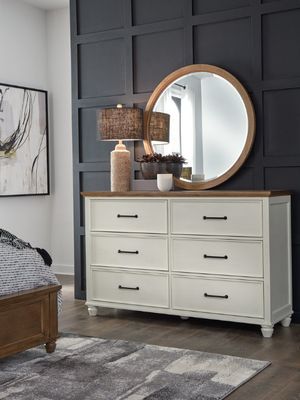
Start here if the corner chair in your room is currently doing a dresser’s job. A dresser and mirror pairing is the anchor storage piece in almost every bedroom layout, giving folded clothes a permanent home and turning a blank stretch of wall into the room’s focal point. The mirror earns its place twice over, since hanging it above the dresser bounces daylight back across the room and makes a darker or smaller bedroom read larger. This is a Vista collection piece in the Hickory Shell finish, which coordinates directly with the Vista chest further down this lineup.
Top Features
- Anchor storage piece: A wide dresser handles the everyday folded clothing that otherwise stacks on a chair or the end of the bed.
- Mirror included as a pairing: Sold together as a two-piece grouping, so the mirror scale is designed to suit the dresser rather than guessed at.
- Light-bouncing placement: Mounted above the dresser, the mirror reflects daylight and makes a small or north-facing bedroom feel more open.
- Vista collection finish: The Hickory Shell tone matches the Vista chest, so the storage side of the room stays visually consistent.
- Clearance planning support: Bring your wall run and the 30 to 36 inches of drawer clearance from earlier and our team checks it against current specifications.
John Thomas Furniture Sanibel Bedroom Macchiato King Panel Bed
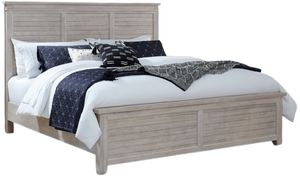
When a bedroom already has warm flooring or honey-toned trim, a cool gray bed will fight it every day. The Macchiato finish on this king panel bed sits squarely in the warm neutral range, which is the undertone family that pairs naturally with oak floors and beige or greige walls. A king footprint measures 76 by 80 inches before the headboard depth, so plan on a room around 12 by 14 to keep the 24 to 30 inch walkways intact. It arrives as a headboard, footboard, and rails, counting as one piece toward your configuration.
Top Features
- Warm macchiato neutral: A softly warm finish that coordinates with oak flooring, warm trim, and beige or greige wall colors.
- King panel construction: Headboard, footboard, and side rails, the classic panel format that suits nearly every bedding style.
- Sized for a primary suite: Best in a room around 12 by 14 or larger so walkways on both sides stay clear.
- Foundation question answered up front: Ask our team whether this model takes a slat platform or a separate foundation before you shop mattresses.
John Thomas Furniture Summit Bedroom Mineral Gray King Panel Bed
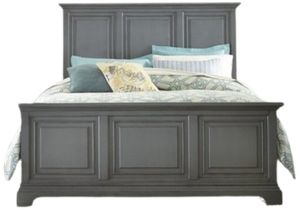
This is the cooler counterpart to the warm neutral above, and the choice between them comes down to the undertone rule from earlier. Mineral Gray leans cool, so it belongs in rooms with gray-toned flooring, cool white trim, or blue and sage wall colors, where a warm brown bed would look out of place. The contemporary panel silhouette keeps lines clean and simple, which lets bedding and textiles carry the personality of the room. Like any king, it needs the wider footprint and full walkway clearance planned before delivery day.
Top Features
- Cool mineral gray tone: A contemporary gray finish suited to cool flooring, white trim, and blue or sage palettes.
- Clean panel silhouette: Simple lines that let layered bedding and textiles set the mood instead of competing with the frame.
- King scale: A 76 by 80 inch mattress footprint, so plan the room and walkways before ordering.
- Undertone counterpart: The cooler alternative to a warm macchiato bed, which makes the finish decision an easy side-by-side comparison in the showroom.
John Thomas Furniture Vista Bedroom Hickory Shell Chest
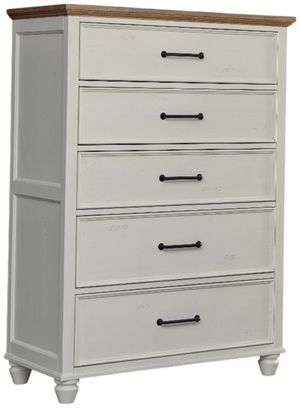
Older homes and apartments are famous for shallow closets, and this is the piece that fixes that without eating the room. A chest stacks its storage vertically, so it delivers serious drawer capacity along a short stretch of wall where a second dresser would never fit. That makes it the natural home for the seasonal bulk described earlier, meaning sweaters and heavy layers that would otherwise fill a closet year round. It shares the Hickory Shell finish with the Vista dresser and mirror above, so the two build the storage side of a coordinated room together.
Top Features
- Vertical storage footprint: Stacked drawers give real capacity while claiming a narrow slice of wall, which is what small bedrooms need.
- Vista collection match: The same Hickory Shell finish as the Vista dresser and mirror, so the two pieces read as one program.
- Seasonal storage solution: Deep lower drawers hold off-season bulk in homes where closet space is short.
- Placement caution: Keep a tall chest clear of low windows and sloped ceilings so it does not block daylight or crowd the wall.
American Drew Summit Beige Canyon Emerson Queen Upholstered Panel Bed
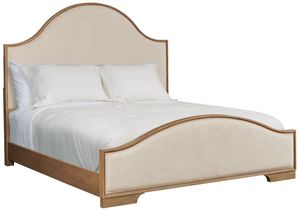
If reading or watching something in bed is part of your evening, a wood headboard stops being charming after about ten minutes. An upholstered panel bed puts a padded surface exactly where you lean, which is the comfort difference people notice most after delivery. This is the queen version of the Emerson bed, with a 60 by 80 inch mattress footprint that fits rooms in the 10 by 12 range while keeping walkways usable. Choose this size when the room is standard rather than generous, and follow the headboard fabric care guidance covered earlier in this article.
Top Features
- Upholstered headboard comfort: A padded surface to lean against, which makes reading or watching television in bed genuinely comfortable.
- Queen sizing: A 60 by 80 inch footprint that fits standard bedrooms around 10 by 12 without crowding the walkways.
- Beige Canyon neutral: A warm, quiet fabric tone that works with wood case pieces in warm finishes rather than competing with them.
- Fabric care planning: Ask about the fabric and cleaning guidance, since a headboard collects hair oil right where people lean.
American Drew Summit Beige Canyon Emerson King Upholstered Panel Bed
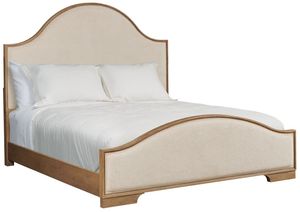
This is the same Emerson upholstered bed as the one above, offered in king rather than queen, so the decision between them is purely room dimensions and not design. A king mattress measures 76 by 80 inches, adding 16 inches of width over a queen, which means the room needs roughly a foot and a half more wall-to-wall space to keep the same walkways on both sides. Choose king when your room measures around 12 by 14 or larger and two people want their own space. Measure first, then pick the size.
Top Features
- Same design in king scale: Identical Emerson upholstered panel styling as the queen, sized up rather than restyled.
- Sixteen extra inches of width: A king adds real personal space for two sleepers compared with a queen.
- Room size requirement: Best in a bedroom around 12 by 14 or larger so the 24 to 30 inch walkways survive the wider footprint.
- Padded headboard: The same upholstered leaning surface, which matters more in a king where people sit up on both sides.
Come see these finishes side by side, ask our team what else exists in each collection, and let us handle delivery and setup so everything arrives assembled and placed.
Bring Home Bedroom Sets That Make the Whole Room Work Together
Pick the piece count by the storage you actually need, size the group by walkway clearances rather than square footage, and match undertones instead of color names, and the room comes together the first time. Whether you buy a full group or build from one collection, those three decisions do most of the work.
Come visit Kelley Appliance Center to compare wood tones and fabrics under one light, see the scale of a king bed against a real wall, and get honest guidance on which configuration your room can actually hold. Our team knows what else lives in each collection, including pieces that are not on the floor, and we handle professional delivery and setup so nothing arrives in pieces on your bedroom carpet. After the sale you reach local customer service instead of a call center, which is the part big-box and online-only sellers cannot match. Shop bedroom sets in the showroom or online and let us do the measuring math with you.
Frequently Asked Questions about Bedroom Sets
A 5 piece bedroom set typically includes a bed, one nightstand, a dresser, a mirror, and a chest of drawers. The bed counts as one piece even though it arrives as a headboard, footboard, and rails, so always confirm the exact included pieces with the retailer before ordering.
A small room of about 10 by 10 feet is best served by a 3-piece or 4-piece bedroom set with a queen bed. Substituting a tall chest for a second nightstand adds drawer capacity without consuming the walkway space a wider dresser would take.
No, bedroom furniture does not have to match, but the room needs a matched core of two or three pieces to feel intentional rather than accidental. Keep undertones consistent, repeat any finish or metal at least twice, and let only one piece act as the visual accent.
Yes, grouped bedroom sets are usually less expensive than buying the same pieces individually over time, and they come with one delivery and one setup appointment instead of several. Buying pieces separately makes more sense when a room has odd angles or when the budget needs to spread across months.
Plan 24 to 30 inches of clear walkway on each side of the bed and at the foot, and 30 to 36 inches in front of a dresser or chest so drawers open fully. Those clearances, not total square footage, are what decide whether a given configuration fits the room.
No, bedroom sets almost never include a mattress or a foundation, and both are priced separately. Confirm whether the bed uses a slat platform or requires a separate foundation before you shop for a mattress to go with it.
Why Trust Kelley?
For over 50 years, Kelley Appliance has been the trusted, family-owned source for home needs in the Central Savannah River Area. When you shop with us, you're not just a customer; you're our neighbor. We take pride in providing a hassle-free experience built on honesty and integrity.
Recognized as the #1 Appliance Store, our Kelley Augusta, GA location specializes in offering a wide selection of top-brand appliances at competitive prices. Our Aiken, SC, location expands on this, providing both appliances and home furniture to meet all your home furnishing needs. With fast delivery and flexible financing options, experience the Kelley difference and see why generations of families trust us to make their home a true haven.
Learn more: